Amaia is currently knee-deep exams, one of which is the Danish equivalent of Nat 5 Art. It’s a serious affair: two years’ worth of artistic output compiled into a neat little portfolio which she has to display in her own art cubicle, polished off with an oral exam in front of an external ministry-appointed examiner next week.
She has to display and categorise her work with all the solemnity of a gallery curator. "Famous artwork redone in the style of another artist," check. "Self-portraits over time to show improvement," check. "Animal portrait in charcoal," check. "Works with varying light sources," check - etcetcetc... "3D clay media sculpture representing your soul, but in the form of lunch," wait, what?
Yes, one category was to make, in clay, a slice of rye bread with your favourite toppings complete with a 2D explanation of the cultural and personal backstory of your sandwich. Some kind of art meets anthropology thing in the most Danish way possible!
Now, Amaia is nothing if not principled. She took one look at this brief and declared, flatly, "I’m not doing that."
"But everyone else is," said the teacher. "I know you're not fully Danish, but look at Farouk, he made a curry to represent his heritage and stuck it on a clay slice of rye bread."
I can only begin to imagine Amaia's reaction to that, she certainly told me in no uncertain terms that she wouldn't be wasting a decent curry by putting it on rye bread, not as long as peshwari naan exists!
They suggested she make something traditionally Scottish on top of the rye bread to represent her blended identity. "It’s about showing who you are!" they encouraged.
Amaia’s response? "No one in Scotland would ever put a potato scone and square sausage on rye bread. It’s sacrilege."
In the end, she stuck to her guns, making a lovingly detailed square sausage, a tattie scone, and a fried egg, layered triumphantly on what she insists is a proper Scottish morning roll.
No rye in sight. No compromise. No apologies.
When I asked if she was worried they might fail her, she shrugged and said, "If they do, it’ll have been worth it to retain my cultural identity."
I have never been prouder. Vive la sausage rebellion.
There are some names that seem to have been permanently cast out of fashion, and way down at the bottom of that list there’s Phyllis. Poor, unloved Phyllis.
I know this because I grew up with it. Even being born in 1968, it was already an old lady name then. My peers were Gillians, Karens, and Sheenas. I was saddled with a name that sounded like it belonged to a distant great-aunt who smelled of lavender and boiled cabbage. While my classmates had those trendy little keyrings with their names on them from Woolworths, I was left empty-handed. Phyllis was not making the cut, even in the 70s.
You’d think that by now, Phyllis would have come full circle. Names like Edith, Martha, Ruby, and Maisie have all made their grand comebacks, trotting back into nurseries and primary schools like nothing ever happened. Even Agnes has had a resurgence, helped in no small part by a certain small, endearing cartoon character in Despicable Me. But Phyllis? No. Maybe I should campaign for a Phyllis character the next time they reboot the Minions?
This morning, just to confirm my suspicions, I checked the Scottish name records. And the results were bleak. Since the year 2000, many Scottish parents have dutifully handed down Phyllis as a middle name—eight pages worth of them, to be precise. Presumably, these poor children are carrying the name as an homage to a beloved (and likely deceased) granny. But as a first name? Just one. One single child in Scotland has been named Phyllis in the last 25 years. That child is now either carrying their name with defiant pride or planning to change it the second they turn 16.
My mum was definitely much more likely to have given me a common, trendy-at-the-time name - my brother is a Derek after all and she was very non-plussed when I chose a foreign name for my first born, despite him being foreign(!), and suggested very strongly that calling him 'Ryan' might have been more appropriate! I was actually meant to be a Linda, till my own granny upped and died six days before I was born. As a child I would often wonder how life would have been for Linda Buchanan? As a shy child, I would have found blending into the background instead of standing out to every teacher and child alike, quite a relief, I imagine.
I can’t say I blame them. Growing up with the name Phyllis was no picnic. While my friends’ names exuded youthful energy, mine sounded like it should be embroidered onto a lacy handkerchief. It felt like a name you were assigned at birth and somehow retired with immediately. If names had default accessories, mine came with a blue rinse and a walking stick.
The question is, why? Why has Phyllis been left to rot in the attic of history while other names of the same era have dusted themselves off and reclaimed their place in baby name books? Is it the sound? The way it doesn’t quite roll off the tongue like a Daisy or an Evie? It has no cuteness rating and sounds positively frumpy. Or is it because no modern cultural icons have emerged to make it fashionable again? No glamorous actresses, no bestselling authors, no inexplicably popular reality TV stars called Phyllis have stepped forward to rescue us from obscurity.
Even the Americans, who have an impressive track record of bringing back old-fashioned names before we do, haven’t touched it. There’s no Phyllis Kardashian, no Phyllis gracing the covers of Vogue. The closest we’ve got is Phyllis from The Office, a lovely woman but definitely the embodiment of Phyllisness - older, frumpier, middle-aged, dead-end job, slightly overweight.
And so Phyllis remains in limbo. A name too dusty for revival, too clunky for reinvention. Maybe in another hundred years, when all other names have been used up, Phyllis will finally get her turn.
To the lone Phyllis born in Scotland in the last quarter-century—if you’re out there, I salute you. You are a rare gem. And if you ever need to talk, I understand. Oh, how I understand.
As promised, or threatened, on my previous breakdown of graduation traditions, the Danish student hat, or studenterhue, is such a legend that it needs a whole post of its own. These hats are more than just a piece of graduation attire; they're a symbol of achievement, camaraderie, and a rite of passage filled with quirky and memorable customs. Different schools have different band colours. A whole list is available on this website, if you are interested!
They are such a huge part of Danish culture that Thomas held this exchange with Amaia's teacher:
Literally:
Hi Bjørn,
Léon's getting his hat on tomorrow, so would it be ok if Amaia leaves 10-20 mins early?
Best, Thomas
Hi Thomas,
Yes! Of course 😊 And many congratulations to Léon! It is a big day. Send him all my best regards and tell him congratulations!
All the best, Bjørn
Can you imagine understanding these messages if you had arrived in Denmark the day before? As a non-Dane, it struck me as a truly bizarre conversation. So, someone is putting on a hat and that not only lets their sister leave a different school early, but evokes all sorts of congratulatory excitement from a former teacher! Odd, indeed!
So, let me take you on the hat journey...
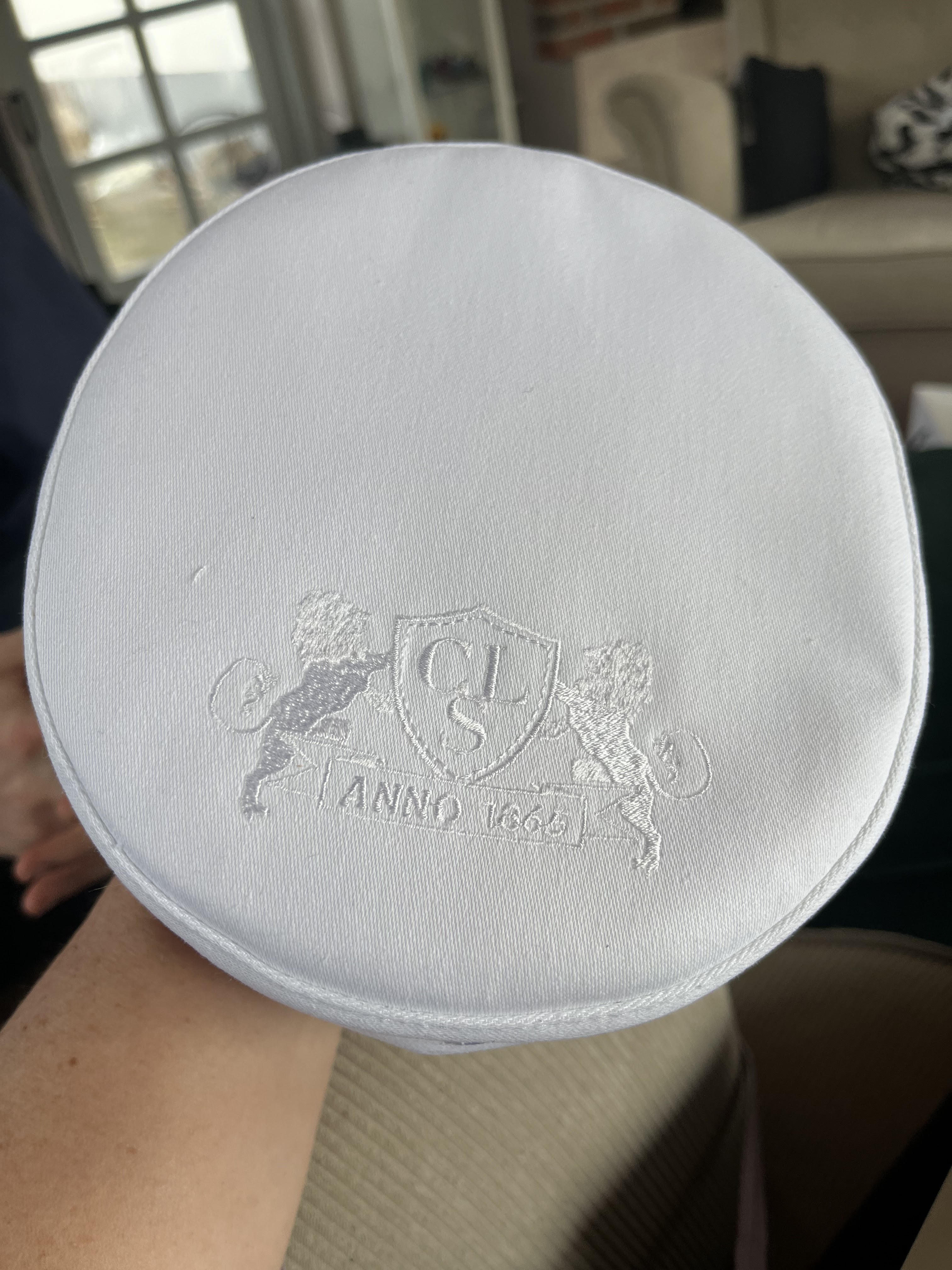
Months in advance, you order it, so it can be embroidered with the name of your school, your name etc. Then, it turns up a couple of weeks before your exams start in a velvet box. (No pressure there, given you earn the right to wear it by passing your exams!) It even comes with built-in pen for your mates to write their greetings, and Léon assures me the even more expensive models come with scissors too, to cut the notches!
First off, putting on the student hat before passing your final exam is considered bad luck. But once you've aced that last oral, or for that matter screwed it up royally, the hat becomes your badge of honour, and the celebrations begin!
After your final oral exam, you walk out of school for the last time on a red carpet, reveal your final mark to your parents, and then write it in the centre of your hat before they place it on your head. It’s a proud moment, marked with cheers, confetti, and lots of Danish-flag-coloured roses.
At that point, out of nowhere Léon's mates appeared to welcome him into the graduate ranks with the famous beer bong, that seems to play quite a major role in this whole rite of passage.
Over the month of July, with nightly parties, the kids try to earn as many symbols as possible for the inside of their hat.
Traditions and Notches
The inside of the hat, including its sweatband end up telling quite a story:
Size Matters: Months ago, when they were measuring their heads with a view to ordering their hats, the students with the largest and smallest hat sizes were duly noted. And again after the graduation when they had all been issued their GPA, the lowest and highest scoring student in each class was again noted. Those four, or perhaps fewer if there happens to be an overlap, have to provide a drink for all their classmates to get the party started.
Greetings Inside the Hat: Friends and classmates write messages inside your hat, cheeky, or sincere, turning it into a keepsake full of memories.
Sweatband/Visor Notches: Various experiences earn you notches cut out in the sweatband or visor. Throwing up from too much partying? That's a triangle in the visor, a visible-to-the-world symbol of your fuck-up. Thirteen parties in and Léon’s hat remains unscathed in this regard... I don't think I'd have predicted that!
24-Hour Mark: If you manage to stay awake for 24 hours straight, you earn the right to turn your hat the other way around.
Of course, from the day after the student truck (the 4th day after Léon's last exam) Léon's has been the wrong way round, but I have noticed more and more of the kids in the photos from his nightly parties have theirs on backwards as time progresses. It's quite handy even, given that means you can read their name, if you can't remember who someone is!
The Symbolic Language
Your hat can become quite the storybook, with symbols denoting your various feats either drawn or cut into the inside. Here is a list of just some of the symbols to be drawn inside or cut into the inner sweatband that Léon has told me about, and how you go about earning them:
Wave: Jump in the sea wearing only your hat.
Square: Drink a case of beer in 24 hours.
Fish: Down 24 shots in 24 hours.
Lightning Bolt: Have sex wearing only your hat.
Circle: Run around a roundabout in your town wearing only your hat.
Cross: Run around the church in your town wearing only your hat. (Yes, nudity, is a leit motif of graduating high school.)
Triangle: Stay awake for 24 hours.
House: Achieve the 24-hour triangle, square for drinking a case, and feel free to add a chimney if you smoke a pack of cigarettes that day too.
Corn: Run through a cornfield wearing only your hat.
Crown: Run around your old school grounds wearing only your hat.
Signpost: Climb a road sign and drink a beer on top.
Tree: Climb a tree and drink a beer sitting on top.
Car: Flag down a random car and have the driver feed you beer from a funnel.
Funnel: Drink beer from a funnel while peeing against a tree.
Submarine: Drink beer from a bong with your head underwater, usually alongside the wave symbol.
So, basically, do anything in the nude and draw whatever you fancy inside your hat! Just as well the nights are reasonably warm at the moment!
Rotating symbols
On the front of each hat is a button-sized burgundy-coloured symbol. Most have a cross, as Denmark is traditionally a Christian country, even if there isn't much church-going still going on. But you can get it with a crescent, or a star of David if you prefer. Léon has no religion, so opted for the initials STX, which is just means grammar school. This symbol can rotate, and you apparently earn the right to turn it upside down by kissing someone of the same gender, if you are straight, or the opposite gender if you are gay. As far as I can see, everyone in Léon's photo has this upside down currently, though it is slightly subtler on the cross ones than on the STX option!😂
Biting the Skip
Lastly, the pristine hat gets a makeover from day one. Friends and teachers bite into the patent leather brim, leaving tooth indentations to symbolise leaving a lasting mark on someone’s life. I became aware of this when during the after graduation buffet, Léon's politics teacher came over to congratulate him and Léon offered to let him bite his hat, and the teacher obliged without a puzzled look. I guess that tradition was probably paused during Covid. I'm so glad the kids weren't hit by that during Gymnasium.
These are the hat rules Léon has mentioned to me but the list is even longer according to the official site (in Danish)!
By the end of the celebrations, the hat is a well-worn, personalised memento of your student days. I must have a wee look inside Léon's next time he's taking a shower, though do I even want to know?! I know he has already clocked up most of the naked ones!😂 In saying that, having a shower wearing only your hat is probably a challenge too, just to guard against your mother getting a peak at what you have been getting up to all night every night!
In a final instalment of the saga, guess whose polling card had the cheek to turn up today?! At 11am, no less!
How can the UK even pretend to be working, if postal votes can arrive five days after the polls close? There's even a complaint questionnaire you can fill out for the electoral commission but for the question: How many days before the election did your polling card arrive?, you only have an option of 0, or positive numbers, so I'm not sure what to make of that.
Bottom line: if they can't even get a polling card to Denmark, an hour's flight away from Edinburgh, I wonder if those of us who've moved to Tahiti will get theirs even in time for the next election!
I drove Anna to work on Saturday for 3pm. As I drove home, the sky took on an interesting shade of slate grey, and an impressive lightning bolt forked the sky from left to right (it would have made a spectacular photo). Turning into my driveway 25 minutes later the heavy rain began. It looked like one of those quick summer showers, so I figured I'd wait out the five minutes before going in. Something hit the roof of my car; it sounded like a medium-sized rock. I was quite surprised given that size of rock could only have been thrown and I wasn't exactly driving under a bridge or similar, I was parked in my driveway! Then the rock noises multiplied and I honestly thought they might come through the car roof; you can hear my shock and fear in the video I linked to above. I'm not usually one for sitting swearing to myself alone in my car, but it was scary as hell! I was imagining it looking like an acne-scarred teenager by the time I exited the vehicle!
After less than a couple of minutes, it all calmed down and I got out to find the weirdest hailstones I have ever seen in my life all around me on the ground.
The car seemed unharmed, so I went back to business as usual... until the sun came out. Between our two houses, we have a perspex roof with grapes growing. I could see circular shadows all over the patio, that I had never seen before. I looked up to notice the roof was completely destroyed, with hundreds of holes where the stones had simply come straight through, and now the sun was shining through them. And then noticed the patio was covered in shards of perspex.
We sit under this roof in the rain, we dry clothes here too when the weather is changeable. What a nightmare! Then, to my horror I realised that this was probably the least of my problems. This 30m2 of wrecked perspex was nothing compared to my 90m2 shed and toolroom with electrical lights and sockets, which is housed in an outhouse on my field. I wandered up and found it in an even worse state.
But, imagine my even greater shock the following morning when all the local newspaper headlines talked about a tornado hitting the coast at 3-15pm the day before, 15km from my house ripping through a popular campsite and causing all sort damage because of the unique large and oddly shaped hail tornados cause! Who knew?
I'm now waiting on the insurance assessor, who seems to be very busy in our area today!
I left school in Scotland in 1985. If truth be told, I didn't particularly want to leave school at that point as, at 17, I felt too young to go off to uni, but being a February baby in Scotland before age deferrals existed meant I had been sent to school at four and had therefore completed all 13 years of education on offer. This is why both of my kids who had the option of deferral (ie who were born after Jan 1 and before Mar 1) were deferred. I felt I spent my whole childhood catching up socially, and I didn't want that for them.
When I left school, I sat my three CSYS exams (Advanced Highers these days) and on the day of the last one, German, I believe, I was told I needed to 'sign out'. Signing out consisted of going to the school office and asking for a form where I was to write my name and the names of my French, German, and Maths teachers. I then visited each of their classes in turn where they signed on the dotted line to say I had completed their course and the corresponding exam.
My best friend back then was studying CSYS History, English, and Higher German, so we had no classes together and that meant she left school on a different day and we didn't even see each other. In fact, as the only pupil in the school sitting CSYS German, my signing out was quite a depressing and solitary anti-climax to thirteen years in the school system.
I handed my form in to the office and was told I was no longer a pupil and was therefore no longer allowed on school grounds. I remember slowly walking down the school driveway to the exit for the very last time. It felt like a sad and solitary end to that era.
There was no graduation, no prom, no party, nothing.
So, when my two older kids left school in Scotland 30/33 years later, I was pleased to see they now got not only a graduation ceremony in the April before the exams, where they were presented with a certificate, and the teachers and pupils gave uplifting talks that made them feel warm and fuzzy but also a prom at the end of the June term so they could all meet up dressed in all their finery in a fancy hotel in town and touch base a last time after the exams were completed. It felt like they were being celebrated and encouraged to remain in touch rather than simply tossed out into the rain, alone. I secretly wished things had been like that back in my day.
Then we moved to Denmark, which meant that my three youngest would be completing their schooling here rather than there and I hoped things would be as celebratory for them as they had been for their older siblings. I needn't have worried!
My oldest Dane just finished school, and omg, do these people know how to celebrate! I'm actually beginning to think the two oldest were hard done by, and my experience was bordering on abuse! The order and magnitude is different, but here is what his Danish school leaving consists of...
At the beginning of May, a week before exams began, they held their equivalent of prom - 'galla' as it is called. Every kid arranged to be driven to school in a fancy car (or, as it turned out at his school on horseback, on a vintage tractor or in a horse-drawn carriage!) They turned up in their evening gowns, suits or in the case of Léon... well, you can probably guess how he dressed.
That night started at 6pm. They had a fancy three-course meal, and the staff gave speeches. One of the students had been chosen a few weeks earlier to give a talk on behalf of the kids. Three guesses who? Shy, he's not. Despite me asking on several occasions whether he wanted me or Thomas to vet his speech for appropriateness, he kept it under wraps and his reminiscing about their three years together was apparently a great hit with the 150 or so kids, though I am not sure what the staff or headmaster made of it. Especially the point in the speech when he thanked everyone's favourite and most diligent co-student 'Chat-GPT' hahahaha.
Things then became serious for a couple of months. In May, they sat written exams in all their 'A' subjects, and then in June, they sat oral exams in their 'A' subjects and defended their SRPs. The SRP is a thirty-page dissertation written in Danish on two subjects and submitted in the spring of their last year. Each student chooses their own topic and which two of their subjects are to be the main focus and those two teachers plus the ministry examiner then mark it for content. Having not seen their mark, the kids are then taken to an oral to defend the dissertation.
Léon chose Samfundsfag (Politics) and English, analysing Scottish Independence political speeches and ads for both the Yes and the No sides back in the Scottish Independence referendum from the perspective of populist content.
A fortnight before the end of June, I heard there was to be a graduation ceremony two days after the final exam, so figured Danish graduation was following the pattern of Scotland. Little did I know that the galla and the graduation were merely the warm-up acts for the main events!
Days before Léon's last exam, a mate asked if he'd been into town to buy his 'white clothes', to which Léon replied 'what white clothes?'. That's when they sat the poor foreign kid down and talked him through his next few weeks.
Firstly, at his final exam, he was meant to wear his white shirt for the first time. His parents were to take the afternoon off work(!) and turn up with his student hat, Danish flags, and a picnic to greet him as he left his last oral. At oral exams in Denmark you are given your mark on the day. After your 25 minute oral the class teacher and the exam board external discuss your mark then call you back in and tell you it. It's not for the faint-hearted, I can tell you, having sat exams here too!
And orals aren't like back home. For starters they aren't a language thing, you get orals in everything from PE to Physics, from Maths to Psychology, from History to Ancient Culture, and of course also in languages. Every kid does at least Danish and two other foreign languages to one of the two highest levels. Léon's 'foreign' languages are English and Spanish, others have English and German or English and French, and before you say he's at a bit of an advantage over his classmates having English as a foreign language, remember, unlike them, he's not only doing Danish at advanced Higher level as it is compulsory, but he's also doing his History, Politics, Spanish, and his dissertation in Danish, which more than balances that out, poor bugger.
So, after the oral you come out of school on the red carpet which has been put down for the graduates, where your parents shower you in confetti, hand you bouquets of red roses and place your hat on your head after you tell them your mark. Possible marks are -3, 0, 2, 4, 7, 10 or 12. If you get -3, or 0, you've failed. If you get 2-12 you've passed. 7, 10 and 12 correspond to A (with 12 being like 90-100%, 10 being 80-90%, and 7 being 70-80%) in Scotland, 4 is B, 2 is C. No one had told us about the confetti or the roses, so we stood out as the weirdo foreigners when we only had his hat and flags, though some of his middle-school friends who hadn't gone to grammar school turned up with fireworks, so that kind of distracted people from our faux pas, especially when the headmaster came running out to tell them exams were still going on, so could they maybe cool it just a little😂.
The last exam is completely random, so Léon was more than pleased to draw English out of the hat, so came out to announce he'd got 12!
The disadvantage to that would unfold later...
Having had his hat placed on his head, it is now meant to stay there for the whole summer! Everyone knows what the hat means. Different types of institutions have different colours. Dark red means grammar school, but I've also seen light blue, dark blue, purple etc. If you have this on, it means you just passed your final school exams, so the streets are full of kids in these.
We had our family picnic in the school grounds with Amaia, who had been allowed out of school early, Anna who was already on study leave, and the kids' friend from Scotland, Emma. Again, looking around I could see so much Danish culture. Despite being a mere picnic, families had brought along crystal champagne flutes complete with fancy red and white ribbons attached to the stems for the occasion. The most intricate Danish smørrebrød were assembled, and stunning cakes pulled from boxes as champagne corks popped. Tablecloths were unfurled, and glass vases of tiny flowers placed on tables. Everyone's grandparents were in tow too, elegantly clad. Danes are such sticklers for detail when it comes to table dressing and formal occasions. Our tablecloth-less, rose-free bench with plastic cups and baguette sandwiches looked like a pigeon amongst a party of peacocks.
That day Léon and his mates went into town to see the Denmark match, and went on to a club till 5am. Technically, it's a great ruse for getting into a club too. No one IDs a kid in a hat as the youngest you can be is 18, but you're more likely to be 19 or even 20. So, if you're 17 and fancy a clubbing holiday, buy one of these hats and go to Denmark the last week of June!
The following day the other half of his class had their final oral, so again it was out clubbing till sunrise and Thursday was even worse as there was a music festival on in Odense... Funen's answer to Glastonbury. I was in serious doubt that Léon would make the 'white clothes photoshoot' at 8am the next day, and the graduation, but he surprised me by being out and showered by 7am despite coming home after 1am.
And it seems almost everyone was sober enough to remember the memo about turning up in white!
We then went along to the graduation ceremony which seemed very un-British to me, or at least very un-Newton Mearnsy. Back home my kids had gone to Mearns Castle High, a state school that prided itself on its consistent place in the top ten in the country. It was a lovely school, caring, and friendly, but also concerned about protecting its image. Speeches at graduation were grandiose, about achievement and the perfect futures the kids would all be able to obtain thanks to their outstanding results etc etc. Not so here, graduation speeches by the head of each of the five main study lines were anecdotal and fun, describing the kids as having arrived in the school as wild beasts who'd needed taming, joking about kids who were less than diligent, whole classes with reputations for doing anything to avoid assignment deadlines. It all seemed more laid-back, and more relatable, given they also praised them for their ultimate success, and the futures awaiting them. There was no covering up the real or less desirable side of things, which was interesting for me as a non-Dane. Those speeches would just never have happened in the school they would have attended had we lived in that parallel universe.
After the ceremony, they disappeared to celebrate again! But given Saturday was to be the biggest day yet, studentervogn day, Léon wasn't too late home. The studentervogn is the thing the majority of the kids had been most looking forward to from the first day three years earlier when they started grammar school. In fact, some kids probably only do the three-year course for this reason, and I am not exaggerating! A studentervogn is a large truck, decked out with banners prepared by the kids, a dance area, drinks etc. Here's a photo of Léon's.
The disadvantage touched upon above is this: If you get 12 in your last exam, you don't get to join the studentervogn till the second stop, having to run behind it all the way, mind you getting the lowest mark in the class is worse as that person apparently has to run in front of it instead, trying not to be run over!
A route is planned stopping at everyone in their main class's house where food, alcohol, and other refreshments are served. Each stop takes around 25 minutes, other than the stops for breakfast, lunch, and dinner which take longer. Between stops the truck is a mobile dance room and the kids party, drink, dance, and sing. With 27 kids in Léon's class and distances of up to 15km between stops, the truck tour was scheduled to take 15.5 hours so had to set out at 7am! They even dropped by their English teacher's house on the way to give a farewell cuddle to Mummy Sussi as they call her. At each person's stop the classmates lined up to welcome the student to their own stop with a beer bong ceremony. I'll include a video of the arrival of the studentervogn, and the beer ceremony. We got it from 5:35 - 6:05.
Apparently another tradition is to moon at passing cars! Danes love nudity! Given it was Léon's stop he got to moon at the car passing our house, except the car didn't then pass, it stopped and the driver and passengers came up the driveway to congratulate the students as it turned out to be Léon's coworkers driving to the local restaurant for their shift. He had to laugh that his workmates were now in possession of a photo of his bare arse hanging out the back of a truck!
Thomas had set out sandwiches and sangria and they were more than pleased with how exotic (ie un-Danish) that was! We did water the sangria down with a bit of ribena just so they would survive the 15 hours, but no one seemed to notice! We were spontaneously joined by the neighbours too which was lovely!
That night they were determined to earn the right to wear their hats backwards - apparently you do that by staying awake for 24 hours, they were also determined to win the right to draw the symbol of a wave inside their hats by skinny dipping in the sea wearing only their hats, not the most sensible combo, but I did notice his phone pinged at the coast around 2am and he returned home the next day looking like this, complete with wave!
That was 30/6. And since then Léon has rarely been seen! Every night he's at a studentergilde (a graduation party) from 6pm to 6am, always staying at someone else's house. He drops by occasionally for a shower, or to pick up clothes, showing off new symbols in his hat. An ear of corn means you have run the length of a cornfield naked, apart of course for the hat! And so on... He's having the time of his life.
Graduation isn't a prom, and a ceremony here, it's a prom, a ceremony, a hat, a picnic, a truck and a party a night for over a month. They sure know how to graduate in style. And now I know why most Danes take a gap year before uni... it's to recover from the graduation ceremony and sober up long enough to actually decide what course to take at uni!
I don't think I've missed any details, but I will update if he fills me in on anything else!