You know when you come across someone foreign on Youtube who claims they can teach you to speak with a 'British accent', that you're in for a fun few minutes. A British accent???? What the hell is a British accent...? well - listen and learn.
If you are native to these islands, I suggest you pause when she reaches the 'garage' because you may need a toilet break, or perhaps you'll simply need to fetch a tissue?
But stick with her all the way through to the second lesson when she's ordering a coffee for Bobby - classic linguistic mince (thanks to John Wells for making my day).
Maybe someone should send her the Scottish lift sketch. If we all speak the same, this might be an eye-opener.
Showing posts with label language. Show all posts
Showing posts with label language. Show all posts
Thursday, July 22, 2010


Tuesday, February 09, 2010
GORDY BOO 'BIKED' MY TOES!

Anna has been amusing us linguistically recently. She has taken to inventing her own very expressive verbs. It started on Xmas day when her cousin Gordon got a new bike. Hampered by the subzero weather, he was trying it out in the hall in his flat as Anna walked out of the dining room. As he ran her over she indignantly wailed Gordy Boo biked my toes! This week another yell was heard from the dining room, this time in our own house. She walked into the kitchen holding her hand aloft crying No-no (her name for Léon) doored my fingers! As a lexicographer, I can't wait for the next instalment of Anna's dictionary of verbs :-)
Sunday, January 10, 2010
THE COLD 'SNAP'

I have an issue with the terminology being used all over the media now. Twice this morning I have heard the cold 'snap' mentioned - once on the politics show with Andrew Marr, once by the Prime Minister, the useless Mr Brown. To me, a snap is a very short period. When the snow and ice have been on the ground for a month, the term 'snap' is out of place and needs to be replaced by something more appropriate such as 'winter'' or 'period'', even if those sound less idiomatic in English.
Sunday, November 01, 2009
A SWEET BILINGUAL ERROR

Last weekend the weather was so dire, we hardly set foot outside. To distract the kids I got Léon and Lots to make biscuits together. They used a Danish recipe. Thomas told them they had to roll the pastry out fairly thin and bake the biscuits for just five minutes. After five minutes I wasn't sure whether they were cooked through because I wasn't entirely sure they'd rolled them thinly enough. Go and ask Thomas what colour the biscuits should be, I told Pudge. He returned and proudly replied pinkish brown! Pinkish brown??? What the hell is pinkish brown, I wondered. I know Thomas never speaks to Léon in English so I translated in my head the words pink and brown into Danish and suddenly I understood. Danish for pink is lyserød, literally light red. I had expected Thomas's answer to be either light or dark brown. Of course Thomas must have said lysebrun (light brown) but when Pudge heard the lyse the only colour he knew beginning lyse was pink. He's obviously never analysed the meaning of the word lyserød and has simply taken it to mean pink, no more, no less. Sweet!
Friday, October 23, 2009
AN INTERESTING TAKE ON LANGUAGE
Anna has quite a few pinafores. This is a nice, cosy option before we need to drag out the winter jumpers. I have noticed when I dress her that if I get her to step into her pinafore she calls it her trousers, whereas if I put it on over her head, she calls it her T-shirt. So clothing doesn't get its name according to its shape or function, but rather by how you get into it! Sweet!

Wednesday, October 07, 2009
TEACHING METHODS

Readers of my blog will have heard me rant more than once about the standard of language teachers we use in our primary schools. Today Charlotte came in with a prime example... Sheepishly she asked me during her homework tonight: "Cul in French is kinda like a rude word for bum, isn't it? That's how everyone I've heard talking French uses it..." 'Of course it is' - I replied - 'it is the equivalent of arse in English'. "I knew that", she said, "but my teacher says it means neck". Being a native to French Charlotte couldn't even make the obvious Scottish phonetic leap from cul [ky] to cou [ku]. To her, despite her being much more reluctant than Marcel to vocalise her French knowledge, there was just no similarity at all between the two vowels that in Scottish English completely merge. When are we going to realize that pronunciation actually matters and getting teachers this bad at French phonetics is helping no one?
Monday, October 05, 2009
LÅG - A POLYSEMOUS PHENOMENON
Now here's an interesting thing for those who speak Danish.
A few weeks ago Thomas (in a moment of madness) bought Anna a set of felt tip pens. I have spent every day since picking pens off the floor (with difficulty, given my shape) and putting lids back on.
Anna can't get the lids off herself so has taken to walking over to you, holding out a pen and saying 'låg'. I assumed Thomas had told her 'låg' was Danish for lid. Anna on the other hand has interpreted 'låg' as something used to close something else. Initially, only pen lids were 'låg'. Then last week it became 'bottle top' and 'jar lid'. Next it became 'zip on Anna's fleece jacket' and finally today 'kitchen drawers', 'the roof on a passing bus' and 'hats' became 'låg' too. Of course, the part of speech is also changing simultaneously with 'låg' becoming a verb used to mean 'to close a door', 'to zip up a jacket' etc. Her logic really is quite ingenious and interesting to analyse.
I'll keep listening to see what else becomes a 'låg' over the next few days...
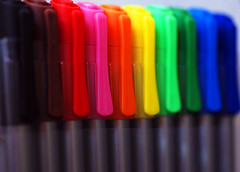
A few weeks ago Thomas (in a moment of madness) bought Anna a set of felt tip pens. I have spent every day since picking pens off the floor (with difficulty, given my shape) and putting lids back on.
Anna can't get the lids off herself so has taken to walking over to you, holding out a pen and saying 'låg'. I assumed Thomas had told her 'låg' was Danish for lid. Anna on the other hand has interpreted 'låg' as something used to close something else. Initially, only pen lids were 'låg'. Then last week it became 'bottle top' and 'jar lid'. Next it became 'zip on Anna's fleece jacket' and finally today 'kitchen drawers', 'the roof on a passing bus' and 'hats' became 'låg' too. Of course, the part of speech is also changing simultaneously with 'låg' becoming a verb used to mean 'to close a door', 'to zip up a jacket' etc. Her logic really is quite ingenious and interesting to analyse.
I'll keep listening to see what else becomes a 'låg' over the next few days...
Saturday, September 26, 2009
MONOCULTURAL BRITAIN
Thomas sent me a link to this the other day but I found it a bit too depressing to blog immediately. I think I first wanted to get it straight in my head what I thought was so depressing about it...
I think the end of the article sums up a great deal of the problem. By banishing language learning from the school curriculum, we lose out on a great deal of culture, literature and the likes in the nations geographically closest to us and therefore isolate ourselves and force ourselves to look outwards to countries that are much more remote such as Australia or the US. (And believe me reading the translation is NOT the same)!
We force ourselves to become monolingual and therefore monocultural which can only result in smaller-minded, less empathetic people. We assume (completely wrongly) that Europe is close and their 'culture' is similar to our own, but unless we learn their languages, we never find ourselves sitting round their dinner tables seeing the differences. By never trying to adapt to all the slight differences between the cultures around us we simply float on the periphery of what everyone else can see.
To me a greater achievement of bringing my kids up bilingually is perhaps their understanding that their French/Danish and Scottish parents are different from each other as are their German/Danish/Scottish/French grandparents. They realize they all behave differently and have different expectations. And of course they have all been used to sitting round a dinner table from birth where three languages are being spoken simultaneously so they all believe bilingualism is normal and not something only 5% of the population should be able to achieve.
I think the end of the article sums up a great deal of the problem. By banishing language learning from the school curriculum, we lose out on a great deal of culture, literature and the likes in the nations geographically closest to us and therefore isolate ourselves and force ourselves to look outwards to countries that are much more remote such as Australia or the US. (And believe me reading the translation is NOT the same)!
We force ourselves to become monolingual and therefore monocultural which can only result in smaller-minded, less empathetic people. We assume (completely wrongly) that Europe is close and their 'culture' is similar to our own, but unless we learn their languages, we never find ourselves sitting round their dinner tables seeing the differences. By never trying to adapt to all the slight differences between the cultures around us we simply float on the periphery of what everyone else can see.
To me a greater achievement of bringing my kids up bilingually is perhaps their understanding that their French/Danish and Scottish parents are different from each other as are their German/Danish/Scottish/French grandparents. They realize they all behave differently and have different expectations. And of course they have all been used to sitting round a dinner table from birth where three languages are being spoken simultaneously so they all believe bilingualism is normal and not something only 5% of the population should be able to achieve.
Tuesday, September 15, 2009
LANGUAGE ACQUISITION

Watching how babies acquire language is a fascinating thing. Obviously, given my taste in men, I will never know the boring, normal, monolingual pattern of language acquisition. A health visitor once told me that bilingualism can slow language till the age of two, though given Marcel could say 'Don't touch that!' as well as half a dozen French nouns long before he could walk, I am slightly dubious. Anna has been slightly different in her learning. Although she understands everything in both English and Danish and has done for some time, she stuck quite rigidly to a core vocabulary of about 30-40 words until the age of 20 months. I am not sure what happened at 20 months and a day however because she decided to switch to the parrot stage, repeating everything in either language, or rather the bits of the words she likes - a horse is a 'ho', a cough is a 'co' and so on. Two, maybe three days after that stage was reached she decided to start having proper conversations with us. Instead of copying us and our sounds, she simply would initiate the conversation. Last week we got 'Daddy pay fwufwu up' - literally 'Daddy play frog up' - ie 'Daddy is taking a shower in the bathroom with the musical bubble frog upstairs'. When she coughs she now tells you spontaneously 'Nana co' - (she calls herself Nana at the moment). In the last week she has become very attached to a plastic baby doll and has conversations with it. 'Baby seat, baby bath, baby wash hair, baby juice'. She has also decided Daddy must wear 'fwoos' to go in the garden and if he dares set foot outside barefoot, we get a hysterical child running around the hall shouting 'Daddy sock, fwoos!' I guess language is here to stay and the point where her language could be documented in its entirety is now in the past.
Monday, July 13, 2009
BAH-DUB-A-DAY!
Bahdubaday seems to be the word Anna has decided to use to mean TV (of course?!)
Granted, it doesn't sound much like TV or telly but we've got to the bottom of it now.
Léon doesn't really watch much TV, but when he is tired or if he wakens up too early to be sociable, he often creeps downstairs and asks if he can watch an episode of Balamory. Because Anna hears Pudge asking to watch Balamory, as opposed to asking to watch TV, Anna thinks that Balamory is the word for TV. And of course Bahdubaday is her attempt at Balamory. So when she asks for Bahdubaday, she may indeed want to watch Balamory, but she may also want you to put on her Danish DVD of Kaj and Andrea. It's quite simple really...
I'm away to write an English-Baby, Baby-English bilingual dictionary now!
Granted, it doesn't sound much like TV or telly but we've got to the bottom of it now.
Léon doesn't really watch much TV, but when he is tired or if he wakens up too early to be sociable, he often creeps downstairs and asks if he can watch an episode of Balamory. Because Anna hears Pudge asking to watch Balamory, as opposed to asking to watch TV, Anna thinks that Balamory is the word for TV. And of course Bahdubaday is her attempt at Balamory. So when she asks for Bahdubaday, she may indeed want to watch Balamory, but she may also want you to put on her Danish DVD of Kaj and Andrea. It's quite simple really...
I'm away to write an English-Baby, Baby-English bilingual dictionary now!
Friday, June 05, 2009
AGE GAPS

I've never found the big age gap between Marcel and the two little ones (8 & 10 years respectively) a particular problem. He loves them both to bits and they worship the ground he walks on. Today however, I had my first problem with it. Léon is used to listening to how his brother views the world and I'm not altogether sure that fits in with the cute 3 year old image... Léon was swinging on our iron garden gate while Marcel was sitting in his bedroom listening to some rap music with the window open. MARCEL, MARCEL!!!!, shouted Léon, as a group of high school girls (of about 13) walked by in their tight skirts and straightened blonde hair. Check out how HOT these girls are, he shouted to his big brother proudly, as the girls walked past giggling. Thanks Léon! grinned Marcel from the window. Yeah - thanks indeed Marcel!
Thursday, June 04, 2009
BILINGUAL DILEMMA NUMBER TWO
I have just listened to Thomas and Léon having a 5 minute long bilingual argument!
Léon is looking at a wildlife picture search book. He came to a page with a giant squid on it. 'Would you look at that giant squid Thomas?' asked Léon. 'Ja, jeg kan godt se blæksprutten!' replied Thomas. (Like all bilingual kids, they often have these two language exchanges.) 'No, it isn't an octopus Thomas, it's a squid - it is bigger than an octopus' (and has two more legs you know!) So Thomas explained over and over that there was only one word in Danish and it covered both animals but to Pudge that just wasn't good enough. Léon brought more and more pictures of squid and octopuses to try to convince Thomas to invent a new word in Danish. He even showed him a toy one as if that would suddenly make him see the error of his ways.
Of course to help explain, I mentioned to Pudge that it was just like both turtle and tortoise being skildpadde in Danish or tortue in French, but that only resulted in him showing him pictures of turtles and explaining they had flippers instead of feet and lived in the water as if, once again Thomas would suddenly find a second Danish word to differentiate between the two shelled creatures.
I just love having bilingual kids. If I had all the money in the world I think I'd take time out to do a PhD on bilingualism :-)
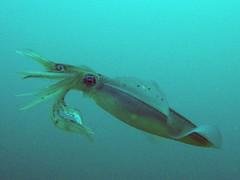
Léon is looking at a wildlife picture search book. He came to a page with a giant squid on it. 'Would you look at that giant squid Thomas?' asked Léon. 'Ja, jeg kan godt se blæksprutten!' replied Thomas. (Like all bilingual kids, they often have these two language exchanges.) 'No, it isn't an octopus Thomas, it's a squid - it is bigger than an octopus' (and has two more legs you know!) So Thomas explained over and over that there was only one word in Danish and it covered both animals but to Pudge that just wasn't good enough. Léon brought more and more pictures of squid and octopuses to try to convince Thomas to invent a new word in Danish. He even showed him a toy one as if that would suddenly make him see the error of his ways.
Of course to help explain, I mentioned to Pudge that it was just like both turtle and tortoise being skildpadde in Danish or tortue in French, but that only resulted in him showing him pictures of turtles and explaining they had flippers instead of feet and lived in the water as if, once again Thomas would suddenly find a second Danish word to differentiate between the two shelled creatures.
I just love having bilingual kids. If I had all the money in the world I think I'd take time out to do a PhD on bilingualism :-)
BILINGUAL DILEMMA NUMBER ONE

Léon's had a morning filled with bilingual dilemmas. I was being a bit lazy so instead of reading an English or French book to Anna and Léon this morning, I picked up the first thing I saw which happened to be a Danish A-Z (or rather A-Å) picture book. All was going well. I was chatting away to Léon in French asking him about various pictures. The first page contained the Danish words for a monkey, a face, an arm, a duck, an elbow, a pineapple and a cucumber which all begin with 'A' in Danish. Pudge was happy for me to mention le singe, le visage, le canard, le coude, le bras and le concombre without a bat of the eyelid, he happily pointed them out for Anna but he got quite upset when I said 'Tu vois l'ananas?' You see, although I am allowed to speak English and French, I am not allowed to speak Danish, just as Thomas is not allowed to speak English. I am allowed to understand Danish and hold conversations where I reply to Danish in English but when I say a Danish word, Léon says 'That's not your word, that's Thomas's word, your word is X'. What had thrown him of course was that Danish has quite a few borrowings from French. So when I mentioned 'ananas', he took it to be Thomas's word for pineapple and therefore thought I was daring to use a Danish word. I tested my theory when we got to 'c'. I was allowed to mention le chocolat, l'ordinateur, le casque and le vélo but le champignon and le citron were no-go areas - they were 'Thomas's words'. It's funny he thinks of these three words as Danish and not French! I guess Thomas is the chef in our house so food's first language in Léon's mind is Danish.
Sunday, May 17, 2009
AND ANOTHER THING ABOUT EUROVISION!
I know I am a language nerd who lives with a language nerd but is it just us who are weird or is Norton particularly linguistically challenged?
Firstly he looks surprised when Romania gives Moldova 12 points when no one else has given them 12 - Look up wikipedia Graham - check which languages the 2 countries speak. Then we get to Finland's 12 points and he says: Oh this is bound to be for Denmark - no Finnish is nothing like Danish - Finnish isn't like much else in the world except Estonian - Thomas and I shout in unison at the screen 12 points to Estonia - and the Finn repeats we give our 12 points to Estonia and again Norton is heard scratching his napper, totally puzzled and so it went on throughout the show. Ho hum!
Firstly he looks surprised when Romania gives Moldova 12 points when no one else has given them 12 - Look up wikipedia Graham - check which languages the 2 countries speak. Then we get to Finland's 12 points and he says: Oh this is bound to be for Denmark - no Finnish is nothing like Danish - Finnish isn't like much else in the world except Estonian - Thomas and I shout in unison at the screen 12 points to Estonia - and the Finn repeats we give our 12 points to Estonia and again Norton is heard scratching his napper, totally puzzled and so it went on throughout the show. Ho hum!
Saturday, May 16, 2009
A MINI EUROVISION RANT
I am sitting here watching Eurovision with Thomas - it's practically his favourite night of the year!
We've just got as far as Albania and I can't contain myself any longer. I understand many people decide to sing in English to reach a wider audience, especially if their native language is obscure. I don't even have a problem with them all singing in English if they like but what I really don't get is why when they insist on writing their own song in English, they don't have an English native speaker cast an eye over it before jumping on stage and assaulting us with nonsense phrases. Even though all the words are English they just do not collocate in English (native English that is). For example, I've just heard this wee Albanian girl singing how she is longing for someone's care - it is just foreign nonsense! Now a Romanian is telling us her hips are glowing and that she's a lonely baby. So far the only song sung in English by a non-native English speaker without a single collocational error is the Danish one and that was apparently written by Ronan Keating so that is hardly surprising. Other than that every single song has had a at least 2 or 3 phrases that are just wrong to native English ears. Maybe I'll add reading the text of potential Eurovision entries to my CV.
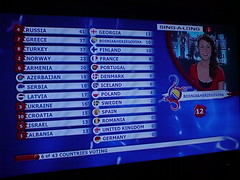
We've just got as far as Albania and I can't contain myself any longer. I understand many people decide to sing in English to reach a wider audience, especially if their native language is obscure. I don't even have a problem with them all singing in English if they like but what I really don't get is why when they insist on writing their own song in English, they don't have an English native speaker cast an eye over it before jumping on stage and assaulting us with nonsense phrases. Even though all the words are English they just do not collocate in English (native English that is). For example, I've just heard this wee Albanian girl singing how she is longing for someone's care - it is just foreign nonsense! Now a Romanian is telling us her hips are glowing and that she's a lonely baby. So far the only song sung in English by a non-native English speaker without a single collocational error is the Danish one and that was apparently written by Ronan Keating so that is hardly surprising. Other than that every single song has had a at least 2 or 3 phrases that are just wrong to native English ears. Maybe I'll add reading the text of potential Eurovision entries to my CV.
Tuesday, May 12, 2009
ONLY ENGLISH-SPEAKING KIDS?

Léon has reached that action figure age where he talks all day long to plastic dinosaurs and the likes and they speak back to him. If he asks you to play with him you can be assured that you are going to have to do the voice-over for some action packed dinosaur adventure. He often likes to ask his dinosaurs questions and have them answer him. Nothing profound... just what they are called, where they live, their favourite food etc. They sometimes fall off the dining room table and are heard to shout 'save me, save me!' Having reached this stage as his siblings did before him, it suddenly reminded me of something I can only assume is peculiar to English-speaking kids. Because they live in an English-speaking country much of the television, and in particular the Disney, Pixar etc movies are in American English, not British English. I have noticed with all my kids that despite not being exposed to much TV, as soon as they start role-playing adventure, they assume a (not very good) American accent, as if somehow all adventure is American! Now, if your kid only speaks French or Danish, I assume they are seeing Pixar dubbed into their native language so don't assume a peculiar accent for role play. Do other non-American English-speaking kids do this? New Zealanders? Australians? Or are my kids just weird?!
Monday, April 20, 2009
CHARLOTTE AND LÉON

I thought when I gave my kids the names Charlotte and Léon-Olivier that those two names were dissimilar enough not to cause any confusion. Silly me! Every day since the kids went to France to visit their Oma, Anna has got up looking forlorn and saying 'Lala, Lala'. Now given Léon called Charlotte 'Lalo' when he first started talking, then 'Latlotte' and now finally Charlotte, I assumed 'Lala' was Charlotte. I showed Anna a photo of Charlotte and asked who that was - Anna replied 'Lala'. Bingo! So all week I assured her every morning that Charlotte would be home soon and gave her breakfast. Last night they returned. Charlotte walked in - Anna shouted 'Lala' and hugged her. Then Léon walked in. 'LAAAAALAAAAA' Anna shouted getting up on her feet for once, walking towards him arms out-stretched before collapsing in his embrace muttering 'Lala, Lala, Lala' over and over. Very confusing!
Friday, February 27, 2009
VI SKAL GIFTES
All week we've been trying, fairly unsuccessfully, to explain to Pudge that we are getting married. There are two problems. He doesn't know we aren't married and he doesn't know what married means anyway.
From time to time Pudge has heard Thomas say Det er giftigt (that is poisonous) when he's gone to eat something he shouldn't.
Today at breakfast Thomas told him again that we're getting married:Vi skal giftes. Is that a good thing or a bad thing? I asked, given how worried he looked. It's a bad thing, he said, lip quivering, You might get dead from that you know!
Poor wee man. Hopefully he'll enjoy the party tomorrow once he susses Thomas is not intending to kill me.

Saturday, February 07, 2009
DANISH
I am not the worst language learner in the world, even if I say so myself. I started French as a small child - primary 4, I think, then German in 2nd year at high school. At uni I first did Italian and then Swedish. Through work I have been forced over the years to confront Spanish and Portuguese. Though I may only be able to speak French, German and Italian, I can certainly read and understand Swedish, Spanish and a wee bit of Portuguese.
That brings me of course to Danish...
When I shared an office with Thomas as mates 6 years ago, I used to listen to him on the phone sometimes to see what I could pick up. He'd mail me the odd link to newspaper articles and with a lot of concentration I could get the gist of them mainly through my very rusty knowledge of Swedish. Over the years I got better and better at reading it but because it isn't pronounced anything like it is written (it is even worse than English and that is saying something), I found it hard to draw the parallel between a written word and its spoken form. For instance the word meget sounds more or less to me (and my French speaking kids) like the French word mal. So why the hell do those weird Danes spell it meget???
Finally, now into my third year of living with a Dane I understand! I know what the written words mean in the newspaper, and when Thomas and his parents sit round my table talking I can follow that too. Result!!!
There are only two problems.
The first is pronunciation. Danish is full of weird sounds and Danes are used to speaking English and less used to English-speaking people attempting Danish. On the odd occasion I attempt a Danish word with Thomas or mention any of his friends by name - he completely demoralizes me by looking totally blank as if I have attempted martian. I mentioned the other day I had been speaking to Lykke on facebook. He had absolutely no idea what I was talking about. Ok, I didn't pronounce it wonderfully but as someone who has tried other languages, French and Germans understand you but laugh no matter how badly you pronounce their language. Danes just look blank. I guess they just aren't used to us foreigners even saying hello :-(
The second major obstacle, and the only point I totally lose the conversation when listening to Danes round the table is numbers. Danes have some weird names for numbers - they are nothing like Swedish or German or English. I have no comprehension whatsoever of Danish numbers. I know the sounds - so I know when they are discussing prices or ages, I just have no clue whatsoever which number they are talking about.
I think I'll start a campaign for a Danish spelling and number reform. And maybe I'll also try to get Thomas to understand foreigners might try a wee bit harder to pronounce it, if he tried a wee bit harder to understand bad pronunciation of Danish!

That brings me of course to Danish...
When I shared an office with Thomas as mates 6 years ago, I used to listen to him on the phone sometimes to see what I could pick up. He'd mail me the odd link to newspaper articles and with a lot of concentration I could get the gist of them mainly through my very rusty knowledge of Swedish. Over the years I got better and better at reading it but because it isn't pronounced anything like it is written (it is even worse than English and that is saying something), I found it hard to draw the parallel between a written word and its spoken form. For instance the word meget sounds more or less to me (and my French speaking kids) like the French word mal. So why the hell do those weird Danes spell it meget???
Finally, now into my third year of living with a Dane I understand! I know what the written words mean in the newspaper, and when Thomas and his parents sit round my table talking I can follow that too. Result!!!
There are only two problems.
The first is pronunciation. Danish is full of weird sounds and Danes are used to speaking English and less used to English-speaking people attempting Danish. On the odd occasion I attempt a Danish word with Thomas or mention any of his friends by name - he completely demoralizes me by looking totally blank as if I have attempted martian. I mentioned the other day I had been speaking to Lykke on facebook. He had absolutely no idea what I was talking about. Ok, I didn't pronounce it wonderfully but as someone who has tried other languages, French and Germans understand you but laugh no matter how badly you pronounce their language. Danes just look blank. I guess they just aren't used to us foreigners even saying hello :-(
The second major obstacle, and the only point I totally lose the conversation when listening to Danes round the table is numbers. Danes have some weird names for numbers - they are nothing like Swedish or German or English. I have no comprehension whatsoever of Danish numbers. I know the sounds - so I know when they are discussing prices or ages, I just have no clue whatsoever which number they are talking about.
I think I'll start a campaign for a Danish spelling and number reform. And maybe I'll also try to get Thomas to understand foreigners might try a wee bit harder to pronounce it, if he tried a wee bit harder to understand bad pronunciation of Danish!
Tuesday, December 23, 2008
AN ENGLISH SPELLING REFORM

Charlotte is a very down to earth practical child. We were out shopping the other day and we passed Starbucks. I think they should change the spelling of coffee she said. Why would you want that? I asked. Well if they just spelled it ccooffee then you wouldn't have to remember which of the letters were doubled! Can you imagine if they put her in charge of an English spelling reform one day?! By the end of the day English might look like Finnish!
Subscribe to:
Posts (Atom)